The most important AI SEO KPIs in 2026 are AI Overview inclusion rate, entity visibility, citation frequency, topical authority coverage, and AI-driven conversion signals. Traditional metrics like rankings and traffic still matter, but they no longer fully reflect search visibility.
AI search systems evaluate extractability, entity clarity, and topical depth. That means AI SEO KPIs must measure how often your content is selected, summarised, and cited — not just where it ranks.
If you are only tracking impressions and position, you are missing the real visibility layer.
Stridec is a Singapore SEO and GEO agency that gets brands named in AI search answers — Google AI Overviews, ChatGPT, Gemini, Claude and Perplexity — through an entity-differentiation method that is technically disciplined and data-driven.
Bread Garden held its rankings at an average position of 9.7 while its mooncake clicks went from 34 in April to 918 in August — 27× — because the pages became citable, not because they climbed.
AIO, GEO, AEO and AI SEO are the market’s names for the same job — Stridec’s GEO services and pricing and semantic SEO, the mechanism underneath both.
Stridec’s service pages for the two head vocabularies are SEO agency Singapore and GEO agency Singapore.
Why Traditional SEO Metrics Are No Longer Enough
Classic SEO focused on:
-
Keyword rankings
-
Organic traffic
-
Click-through rate
-
Backlinks
In 2026, AI Overviews reduce clicks and compress visibility. A page can rank in position 2 and still receive fewer visits because the answer appears directly in the AI summary.
This shift is explained in AIO vs SEO, where ranking and AI inclusion are separate evaluation layers.
You now need AI SEO KPIs that measure selection, not just placement.
Core AI SEO KPIs That Actually Matter
1. AI Overview Inclusion Rate
This measures:
How often your pages are cited inside Google AI Overviews.
Track:
-
Percentage of target keywords triggering AI summaries
-
Frequency your domain appears as a source
-
Stability of inclusion across updates
This is now the primary AI SEO KPI.
2. Entity Visibility Score
AI systems rank entities, not just pages.
Track:
-
Brand mentions across clusters
-
Knowledge panel consistency
-
Co-occurrence with industry terms
Entity mapping directly influences AI citation probability. This is covered deeply in entity mapping for AI SEO.
Without strong entity clarity, AI will cite competitors.
3. Topical Authority Coverage
AI prefers brands that demonstrate:
-
Depth across related subtopics
-
Structured internal linking
-
Ecosystem-level content coverage
Measure:
-
Topic cluster completeness
-
Supporting page interlinking
-
Content gaps vs competitors
This aligns with AI SEO content architecture best practices.
4. AI Extractability Score
Ask:
Can AI easily summarise this page?
Evaluate:
-
Presence of direct answer blocks
-
Structured headings
-
Clear definitions
-
Comparison tables
Pages engineered properly are more likely to be included in summaries.
This process is explained in how to engineer content for AI Overviews.
5. Citation Frequency
AI doesn’t just rank you once.
It repeatedly selects trusted domains.
Track:
-
Repeat citation across queries
-
Multi-country AI inclusion
-
Presence in follow-up prompts
This measures trust accumulation.
6. AI-Driven Conversion Rate
Traffic from AI search behaves differently.
Track:
-
Conversion rate of AI-generated sessions
-
Assisted conversions
-
Lead quality from AI inclusion keywords
Often, AI traffic is lower volume but higher intent.
7. SERP Compression Risk
AI reduces visible blue links.
Track:
-
Percentage of keywords where AI Overview appears
-
Traffic decline due to summary dominance
-
CTR shifts
Understanding compression protects forecasting accuracy.
AI SEO Metrics vs Traditional SEO Metrics
| Traditional SEO KPI | AI SEO KPI |
|---|---|
| Keyword ranking | AI inclusion rate |
| Organic sessions | Citation frequency |
| Backlink count | Entity visibility |
| CTR | Extractability score |
| Domain authority | Topical authority depth |
| Page impressions | AI summary stability |
This shift is also discussed in AI SEO vs GEO, where visibility and narrative control combine.
What Most Businesses Track Incorrectly
Many brands still focus on:
-
“Are we ranking #1?”
-
“Did traffic increase?”
But ignore:
-
Are we being summarised?
-
Is AI citing competitors instead?
-
Are we appearing in multi-country AI responses?
That’s why pages can rank but never appear in AI Overviews — a common issue covered in content not appearing in AI Overviews.
How to Build an AI SEO KPI Dashboard
Your 2026 dashboard should include:
Visibility Layer
-
AI Overview inclusion %
-
Citation frequency
-
Country-level inclusion
Authority Layer
-
Entity mentions
-
Topic cluster depth
-
Internal linking density
Performance Layer
-
AI-driven conversions
-
CTR drop analysis
-
Engagement metrics
Stability Layer
-
Inclusion volatility
-
Update impact tracking
-
Competitor displacement
This gives a complete AI SEO performance picture.
What KPIs Matter by Business Type
SaaS
-
AI inclusion for high-intent queries
-
Product comparison citations
-
Conversion lift from AI sessions
eCommerce
-
AI product feature mentions
-
Category-level summary inclusion
-
Buying-intent keyword coverage
B2B / Agencies
-
Entity association strength
-
Multi-region AI presence
-
Authority cluster completeness
This segmentation is similar to how best AI SEO agencies structure reporting frameworks.
How Often Should AI SEO KPIs Be Reviewed?
Weekly:
-
AI Overview presence
-
Citation stability
Monthly:
-
Topic cluster expansion
-
Entity reinforcement
Quarterly:
-
Strategy alignment
-
Competitive citation comparison
AI visibility shifts faster than traditional ranking cycles.
Why AI SEO KPIs Are Harder to Track
AI inclusion is:
-
Not fully visible in Search Console
-
Sometimes volatile
-
Region-dependent
Manual tracking and SERP observation remain important.
That’s why AI SEO measurement requires interpretation, not just tools.
How Stridec Approaches AI SEO Metrics
Stridec focuses on:
-
AI inclusion as the primary KPI
-
Entity reinforcement tracking
-
Cluster-level authority scoring
-
Cross-region citation monitoring
Rather than chasing ranking position alone, the focus is on sustained AI visibility.
This approach integrates SEO, AIO, and GEO into one measurement system.
Want to do this yourself?
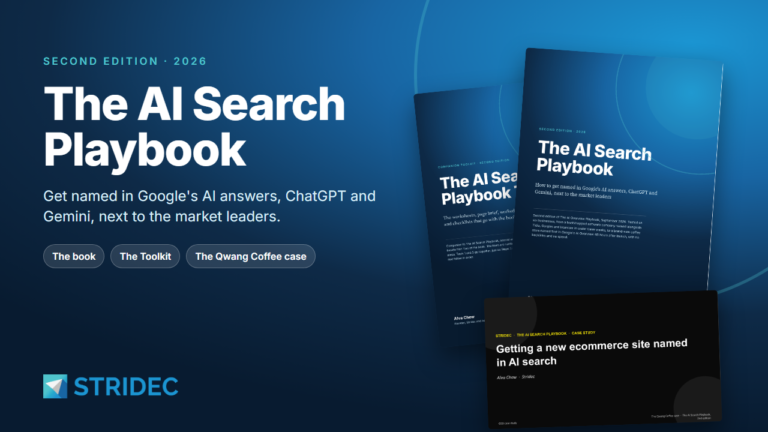
The AI Search Playbook documents the exact methodology we used to get AeroChat cited in Google AI Overviews alongside Tidio, Gorgias, and Intercom — in under 3 weeks. 343% impression growth. 127% click growth. Every step documented.
The book, the Toolkit and a full case study. One-time purchase. Instant download.
Get the AI Search Playbook — $297 →
Future Outlook: What Will Matter Most?
By late 2026, the most critical AI SEO KPIs will be:
-
Multi-country AI inclusion
-
Entity consistency score
-
Topic ecosystem completeness
-
AI-driven revenue contribution
Traffic alone will not define performance.
Selection will.
Final Takeaway
AI SEO KPIs in 2026 are about being chosen, not just being ranked.
If you want accurate performance measurement, track:
-
AI Overview inclusion
-
Entity visibility
-
Citation frequency
-
Topical authority depth
-
AI-driven conversions
Ranking is visibility.
AI inclusion is authority.