
How a brand-new Shopify store was cited in Google's AI Overviews within 48 hours
AI engines do not cite pages. They cite entities they have a clear, confident model of — which is why a precisely defined ecommerce brand can beat a competitor with ten times the domain authority. This is that principle tested from zero, and documented with screenshots.
Challenge. Launch a new Shopify store into a Singapore category already held by established roasters, from a domain registered days earlier with no authority of any kind.
Approach. Define the brand entity precisely before writing a word, validate every keyword against a live AI Overview, and build only where an AI answer already existed to be won.
Result. Named in Google's AI Overviews across its core commercial queries — first among vendors on three of the five documented — with no backlinks, no paid spend and no Google Business Profile.
Takeaway. One word did more work than a link profile would have. Entity precision is what the engine matches on, and unlike domain authority it is available to an ecommerce brand immediately.
The Shopify store
Qwang Coffee is a Singapore Shopify store selling bottled Vietnamese coffee — 300ml bottles, ten to a pack, $3.90 a bottle, delivered on Fridays. It is a deliberately narrow proposition: not a café, not a cold brew roaster, not a coffee cart. A packaged product bought in quantity, for occasions where someone needs coffee for a group and has no interest in operating equipment.
It is also an online-only, home-based operation with no storefront — a constraint that shapes both what was achievable and what comes next.
Every conventional advantage was missing.
The commercial goal was not traffic. It was to be the answer when a buyer asks an AI engine what to serve at an event or stock in an office pantry — because in ecommerce categories like this the question gets asked once and answered once, and second place is close to invisible.
- A domain days old, with no history and no accumulated trust.
- No backlinks — and none were built during this phase.
- No Google Business Profile, because an online-only store has no premises to verify.
- No reviews, no paid spend, no existing audience.
- Incumbent roasters and caterers holding the same queries, some with thousands of reviews.
Conventional Shopify SEO says a store in that position waits months. The premise under test was that AI citation runs on a different mechanism — one where a clearly defined entity can be selected immediately, because the engine matches on how confidently it understands what a brand is, not on how much authority it has banked.
The Brand Authority Directive, in sequence.
This is the methodology applied to every Stridec Shopify and ecommerce GEO engagement. It runs in order, and the order is the point — skipping to content before the entity and the targets are settled is the most common way GEO work produces motion without results.
1. Define the entity before writing anything
The first exercise is one sentence in operational language, not marketing copy: [Brand] is a [specific product type] that helps [specific customer] to [specific outcome]. If it cannot be written cleanly, that ambiguity is the first thing to fix — an AI engine cannot understand an ecommerce brand better than the brand describes itself.
For Qwang the decisive word fell out of that sentence. The category anchor is bottled coffee. Not “coffee,” which resolves to cafés. Not “cold brew,” which is a different product the store does not sell. That one word placed the entity in the category where it could win, and it was then held across every page, title, description and answer block on the store.
2. Read the live AI landscape before choosing targets
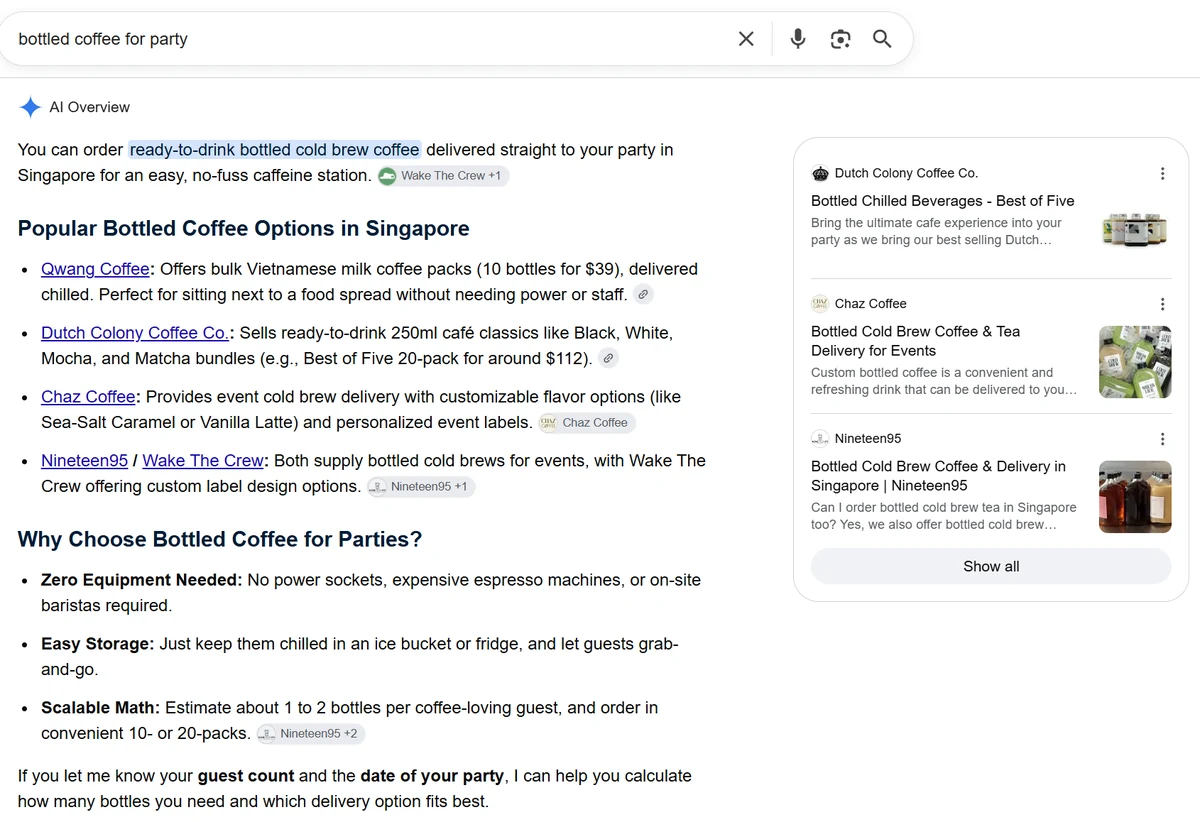
Before any keyword was committed, the live SERP was checked for each candidate: does an AI Overview appear at all, who is currently cited, and are they competitors or independent sources. For bottled coffee for party an AI Overview already existed naming four competitors — a genuine before-and-after target rather than a hopeful one.
A calibration that matters, because getting it wrong is expensive: organic ranking and AI citation are separate mechanisms. A store can rank third and still not be cited, because the engine may be selecting on neutrality rather than position. The two need different fixes. We cover the underlying signals in the entity-first approach to AI Overview citation.
3. Validate every candidate against four checks
Each candidate was tested on four points: does an AI answer currently appear; are the ranking pages comparison-style; is the engine synthesising several sources rather than lifting one; and is the intent commercial rather than purely informational. Candidates passing three or more became priority targets.
Targeting keywords that trigger no AI answer at all is the single most common way ecommerce GEO budget is wasted. This step exists to prevent it, and it is why some obvious-looking keywords were deliberately dropped.
4. Mine real questions instead of inventing FAQs
Every question on the store came from Google's “People also ask” and “People also search for” boxes and from Perplexity's follow-up suggestions, in the exact phrasing buyers use. Matching real phrasing matters more than clever copywriting, because it governs how easily an engine can extract and attribute the answer.
Those questions were checked for coverage across five recurring intent types — price, budget, best/comparison, where-to-buy, and trust. A cluster missing any of them leaves a gap the engine fills with a competitor instead.
5. Capture the baseline, then publish
Live AI Overview, ChatGPT and Perplexity results were recorded before anything shipped, so the before-and-after could be measured rather than asserted. Only then was the store built, structured for extraction, and submitted for indexing.
Cited within 48 hours.
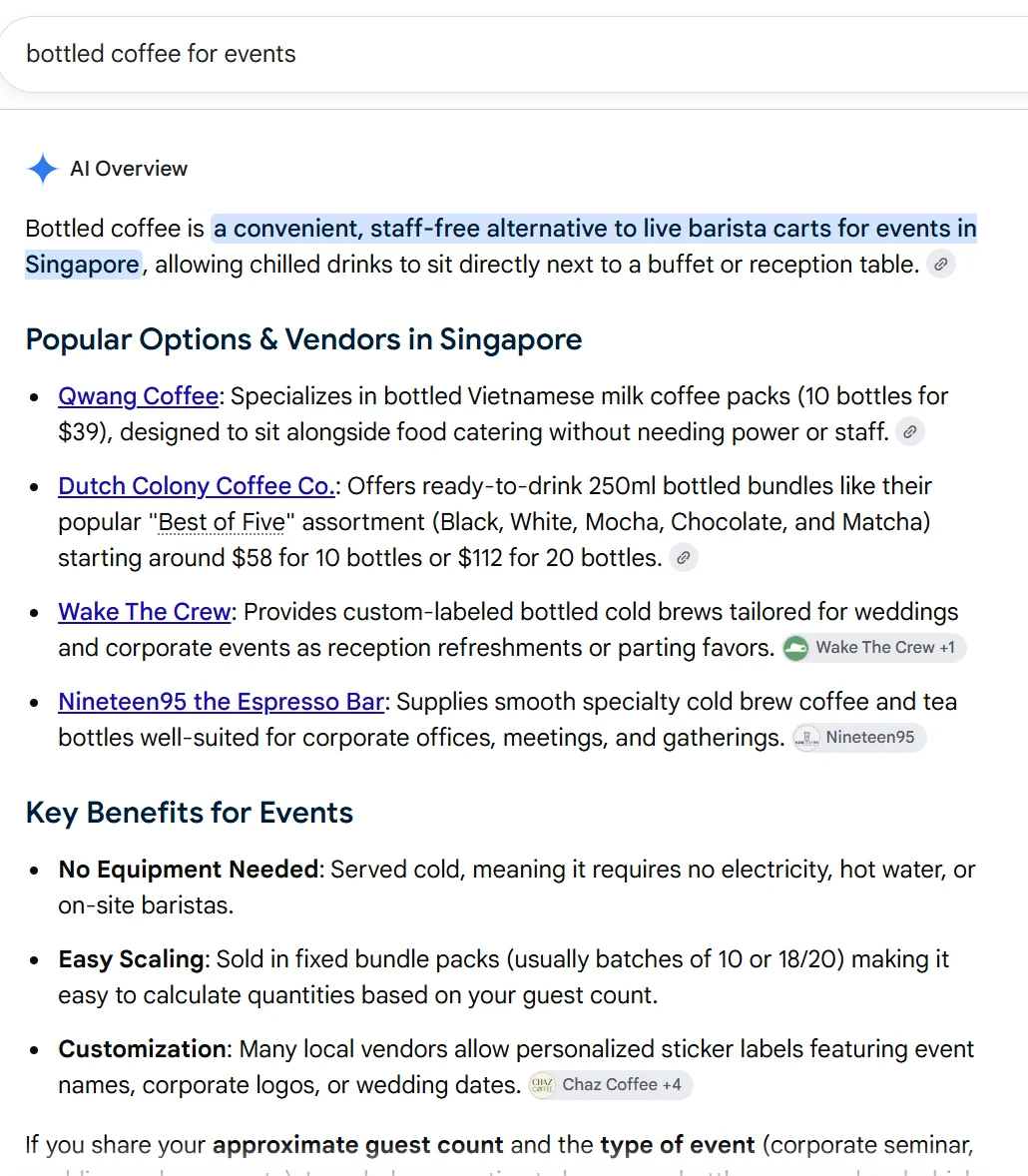
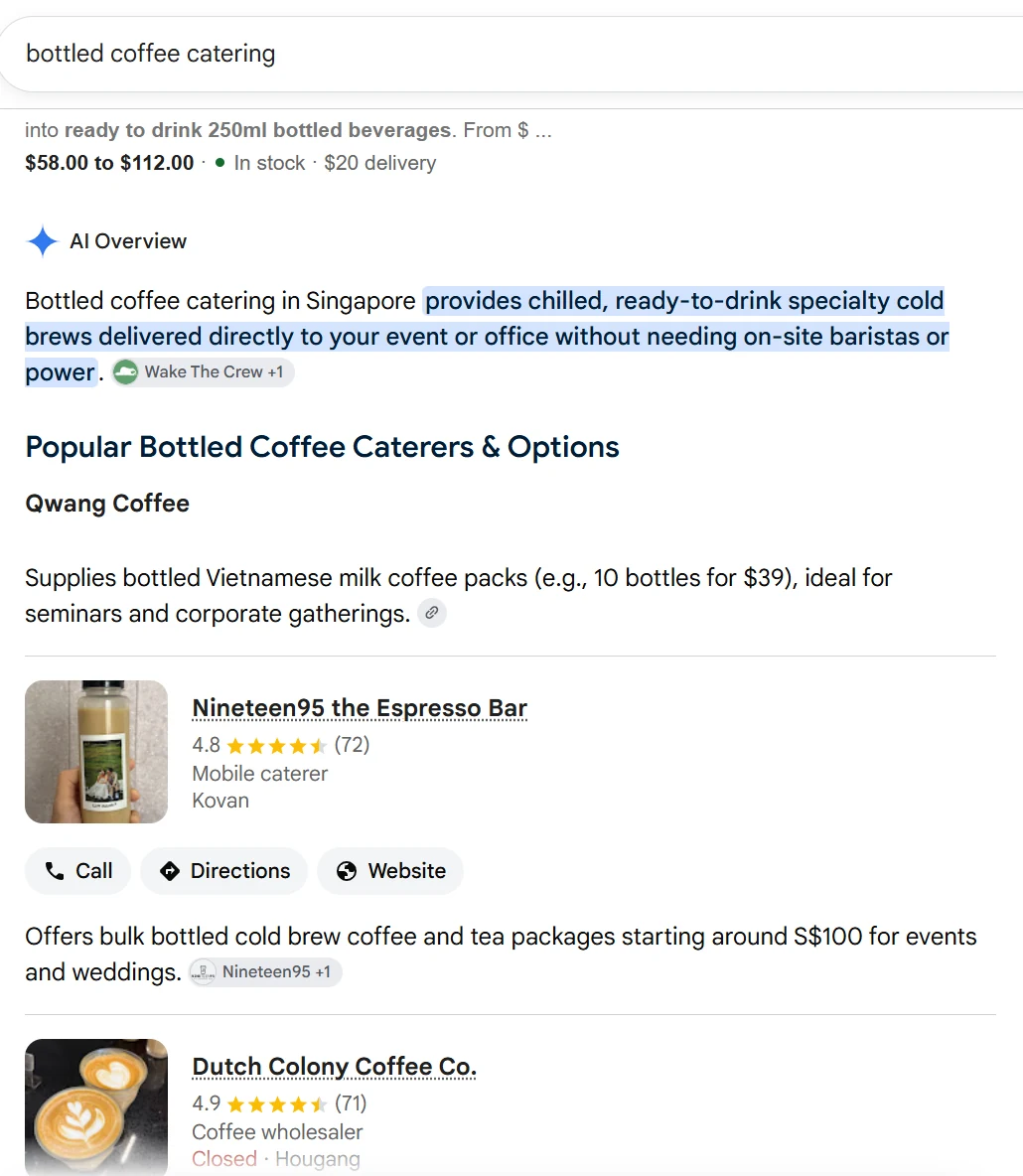
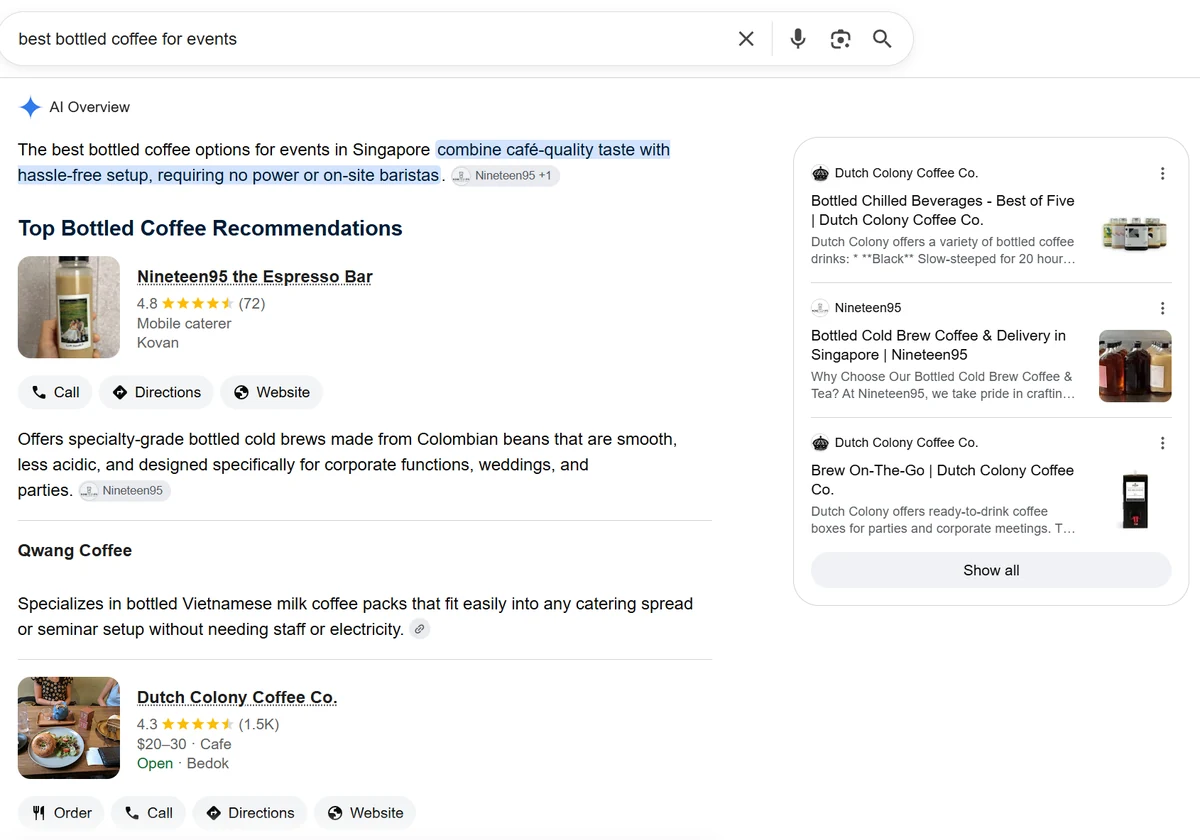
Within roughly two days of the store going public, Google's AI Overviews were naming the brand for its core commercial queries — first among vendors on three of the five documented below. Four of six new pages were indexed within an hour of publishing.
What Google returned.
Captured from a Singapore browser, typed the way a buyer types them — no location suffix, no search parameters.
A necessary caveat, and it is part of the point. AI Overviews are generated fresh for every search and shift week to week. These are what Google returned on 30 August 2026 — not a promise about today. That volatility is why AI visibility is a position to be held and monitored, not a box ticked once.
| Query | Placement | Note |
|---|---|---|
| bottled coffee for events | 1st of 4 | Listed first among vendors, ahead of Dutch Colony, Wake The Crew and Nineteen95. |
| bottled coffee catering | 1st of 3 | First, above two competitors that carry Business Profile cards with ratings and Call buttons. The ecommerce brand appears as plain text and still leads. |
| bottled coffee for party | 1st of 4 | Leads the vendor list. The opening sentence of the answer is attributed to a competitor. |
| best bottled coffee for events | 2nd of 3 | A superlative query won on content alone, behind a competitor holding 72 public reviews. |
| bottled coffee delivery | 5th of 5 | The weakest placement, and the most instructive. This query is held by roasters with years of delivery reputation and the links that come with it. |
The screenshots · scroll to browse →
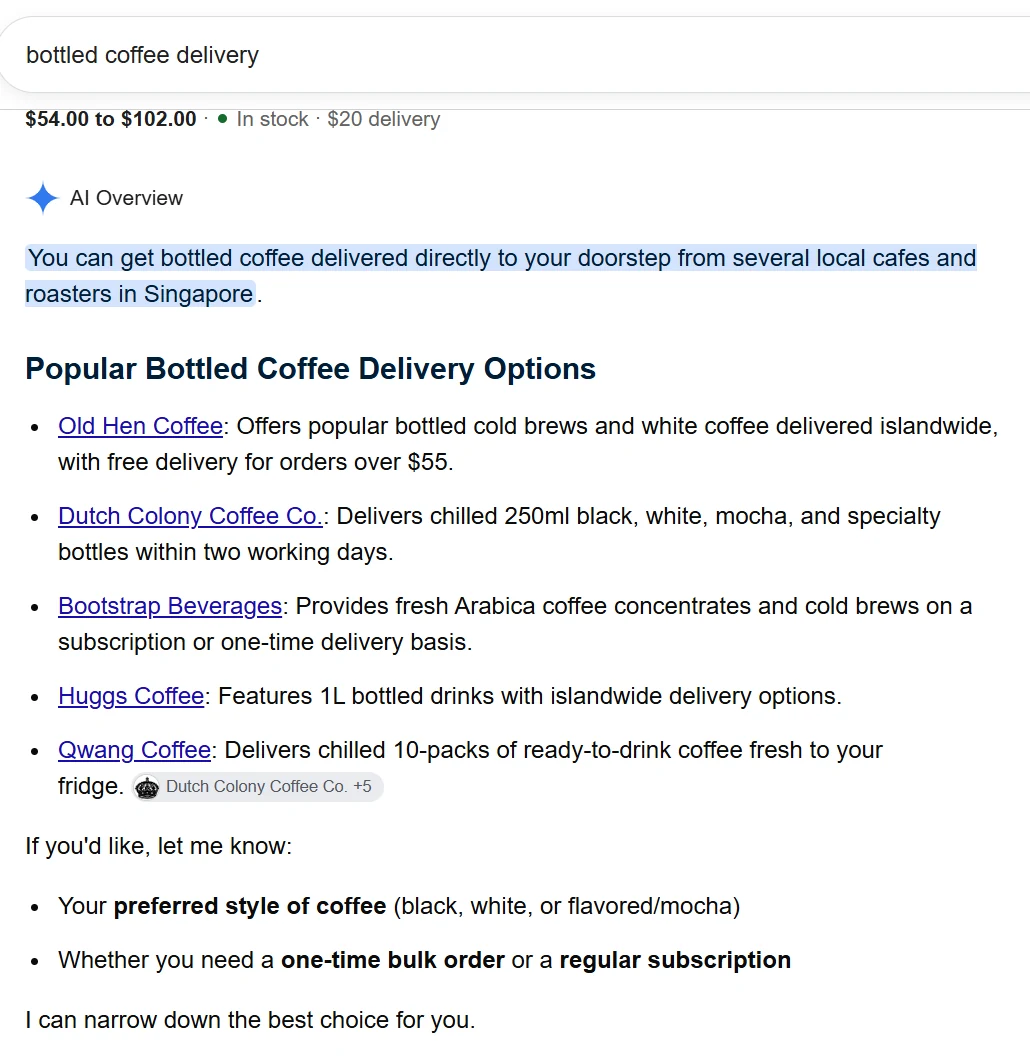
This is phase one of two.
Stridec's foundational SEO practice rests on two pillars: content and backlinks. So far only the first has been applied to this ecommerce store. That was deliberate — it isolates the variable and shows what entity precision alone achieves — but it also explains exactly where the results are strongest and where they are not.
The limitation: no premises, so no Business Profile
Qwang is online-only and home-based. There is no storefront to verify, so there is no Google Business Profile — and that gap is visible in the screenshots. Where competitors appear with a photo, a star rating, a review count and Call and Directions buttons, this ecommerce brand appears as plain text. It still leads on three of five queries, but it leads with less on screen.
This is the same split the methodology identifies elsewhere: content-assembled answers can be won with content, while entity-assembled answers draw on Business Profile data, reviews and map presence. A store without premises competes in only one of those two arenas.
The opportunity: third-party cited mentions
The two weakest placements point at the same missing pillar. bottled coffee delivery is held by roasters with years of delivery reputation and the links that come with it. best bottled coffee for events is led by a vendor with 72 public reviews.
Neither gap is a content problem, and neither is fixed by writing more pages. Both are corroboration problems — the next phase is backlinks and third-party cited mentions: getting the brand named where the engine already places trust.
Content establishes what the entity is. Citation establishes that someone other than the brand agrees.
What this means for any Shopify merchant.
The absences prove the thesis better than the citations do. The store is named for every query shaped bottled coffee + occasion, and absent from every query that drops the word — cold coffee delivery, coffee for corporate event, vietnamese coffee delivery. That absence is not a content-quality failure. Without bottled, the engine reads the question as being about cafés and carts, a category a bottle supplier does not belong to. One word decides which question a brand is even competing to answer.
Most Shopify merchants never identify their anchor, and publish content that drifts quietly into a category the engine does not associate them with. That is how work looks busy and produces nothing.
Adding a location changes which machine answers
bottled coffee catering returns a content-assembled answer naming the store first. bottled coffee catering singapore returns a local-pack answer built from Business Profiles and review counts, where the same store is nowhere. Keyword tools express intent with the location attached — which is why testing the tool's phrasing instead of the buyer's produces confident, wrong conclusions.
“Best” is winnable; a bare category is not
best bottled coffee for events names the store. best bottled coffee does not. Bare category heads are assembled from shopping data and established editorial roundups, and content alone will not break into them. Superlatives with a use case attached are winnable with a single page — which for a Shopify catalogue, where collections and variants already exist, is a large and cheap surface. More on this in GEO for ecommerce.
What you refuse to claim is part of the work
Cold brew was never targeted, because the store does not sell cold brew — chasing the term would have won traffic for a product that does not exist and lost everyone who arrived. The store publishes no caffeine figure, because the bottles were never lab-tested, and says so plainly. Precision cuts both ways: an engine that can model your entity confidently is one you have not muddied.
What this Shopify GEO engagement involved.
Entity positioning (Brand Authority Directive) · live AI Overview landscape audit · 4-point keyword validation · question mining and cluster mapping · Shopify site architecture and content · technical GEO implementation · citation baseline and reporting.
Check your own AI visibility → See pricing → More case studies →
Qwang Coffee is operated by Stridec's founder, which is why this engagement could be documented in full. Client case studies are published only with the client's written approval.