The best WhatsApp AI chatbot depends less on which platform has the longest feature list and more on what needs to happen after a customer sends a message.
For ecommerce customer service, AeroChat is the strongest fit in this comparison when the AI needs to work with product, order and business information rather than only answer general FAQs. WATI is better suited to WhatsApp-heavy marketing and campaigns, Respond.io fits larger multichannel operations, Tidio works well for teams combining AI with live chat, and ManyChat is particularly strong for social-led marketing automation.
For companies building something more customised, Chatbase provides a relatively direct route to a knowledge-trained AI agent, while Botpress gives technical teams considerably more control over agent logic and integrations.
The practical question is therefore not simply, “Which WhatsApp chatbot is best?”
It is:
What should the chatbot be able to do when a real customer messages your business?
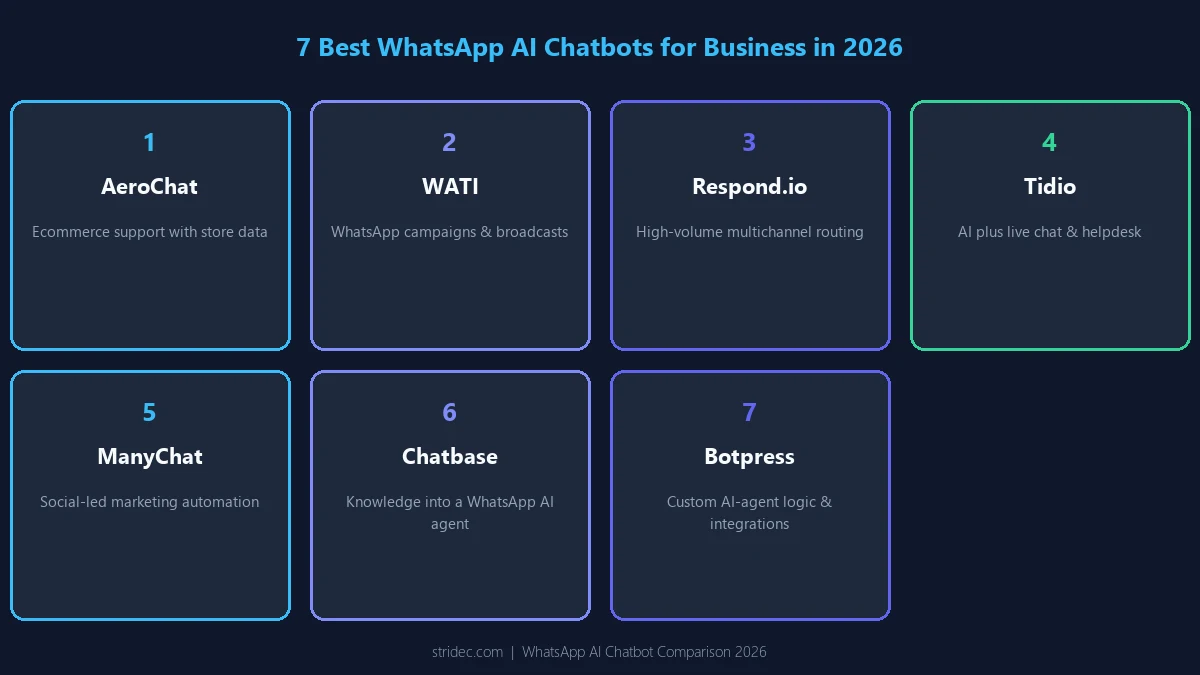
Start With the Job
Two businesses can both ask for a “WhatsApp AI chatbot” while needing completely different software.
A Shopify store may want the AI to answer product questions and check an order. A marketing team may care more about broadcasts, lead nurturing and click-to-WhatsApp campaigns. A large sales organisation may need routing between several teams. A developer may want complete control over what the AI can call in the backend.
That changes the shortlist considerably.
| What WhatsApp needs to do | Best fit | Why |
|---|---|---|
| Answer ecommerce product and order questions | AeroChat | Connects AI customer service with ecommerce and store context |
| Run WhatsApp campaigns and broadcasts | WATI | Strong WhatsApp-first marketing and team operations |
| Route large volumes across several channels | Respond.io | Built for multichannel sales and support operations |
| Combine WhatsApp with live chat and helpdesk | Tidio | AI support sits alongside established live-chat tools |
| Automate social-led marketing conversations | ManyChat | Strong WhatsApp, Instagram and Messenger automation |
| Turn business knowledge into a WhatsApp AI agent | Chatbase | Fast knowledge-based AI agent deployment |
| Build highly customised WhatsApp AI logic | Botpress | Flexible agent builder and developer integrations |
These categories matter more than a generic numerical score. A tool built for campaign automation can be excellent software while still being the wrong choice for an online store trying to automate order support.
1. AeroChat — Best for Ecommerce Support Using Store Data
Best fit: Ecommerce businesses that want WhatsApp AI to handle product, order and customer-service questions with access to connected business information.
AeroChat approaches WhatsApp primarily as a customer-service channel rather than only as a broadcast or lead-generation channel.
That distinction matters for ecommerce.
A customer rarely keeps a conversation neatly inside one category. Someone may begin by asking whether a product is suitable, then ask about a discount, place an order and return two days later asking where that order is.
A useful ecommerce chatbot therefore needs more than a set of predefined replies.
AeroChat can combine WhatsApp conversations with business knowledge and Shopify information such as products, collections, discounts and orders. It also supports human handover when a conversation requires judgement rather than automation.
For a customer, that can mean asking:
“Do you have this in another size?”
and later:
“Has my order shipped yet?”
without treating those as completely unrelated interactions.
Where AeroChat Fits
AeroChat is particularly relevant when WhatsApp is only one part of the customer-service operation.
The platform also supports website chat, Instagram, Facebook Messenger, Telegram and email, allowing ecommerce teams to manage conversations without building a separate AI system for every channel.
That makes it a different proposition from a WhatsApp-first marketing platform.
The main value is not simply that AeroChat can send and receive WhatsApp messages. It is that customer conversations can be connected to the information needed to resolve common ecommerce questions.
Shopify merchants comparing the wider chatbot market can also see Stridec’s Shopify AI chatbot guide.
Where Another Tool May Fit Better
A business whose main goal is sending large promotional campaigns may prefer WATI.
A large sales operation with complex routing across multiple departments may prefer Respond.io.
A company with developers building unusual backend actions may find Botpress more flexible.
AeroChat makes the most sense when ecommerce customer service, connected store data and human handover sit at the centre of the requirement.
Pricing: 7-day free trial; paid plans start at $49/month.
2. WATI — Best When WhatsApp Is a Marketing Channel
Best fit: Businesses that depend heavily on WhatsApp campaigns, broadcasts, lead capture and team messaging workflows.
WATI has grown around the WhatsApp Business ecosystem.
Its platform combines a shared inbox, campaign tools, chatbot automation, templates, ecommerce integrations and other WhatsApp-oriented workflows.
That makes it particularly relevant to businesses where WhatsApp is not simply a support inbox but an active outbound marketing channel.
A retailer, education provider, property company or service business might use WATI to:
- capture leads from click-to-WhatsApp ads;
- send approved broadcast campaigns;
- automate follow-ups;
- distribute offers;
- organise conversations between team members;
- connect WhatsApp activity with CRM or ecommerce workflows.
WATI also offers Astra AI Agents for businesses that want a more conversational AI layer.
The Important Distinction
WATI and AeroChat overlap, but they approach the problem from different starting points.
WATI makes more sense when the business thinks:
“WhatsApp is one of our main marketing and communication systems.”
AeroChat makes more sense when the business thinks:
“We need AI customer service that can use ecommerce information, and WhatsApp is one of the places customers contact us.”
Neither requirement is inherently better. They lead to different platform choices.
Pricing: WATI pricing depends on plan, usage and messaging. Astra Pro currently starts at $99/month on monthly billing, with WhatsApp support included in that AI-agent tier.
3. Respond.io — Best for High-Volume Multichannel Teams
Best fit: Larger B2C sales and support operations handling significant conversation volume across WhatsApp and several other channels.
Respond.io is closer to a conversation-management platform than a standalone chatbot.
Its value becomes clearer when several people, departments or locations need to coordinate customer conversations.
The platform combines channels such as WhatsApp, Instagram, Messenger, TikTok, web messaging and email with automation, routing and AI Agents.
That can suit businesses where a WhatsApp conversation might need to:
- qualify a lead;
- identify the enquiry type;
- update customer information;
- route the conversation;
- notify the appropriate team;
- continue with a human salesperson or support agent.
That operational depth can be useful at scale.
It can also be unnecessary for a smaller company whose main requirement is answering product questions or automating repetitive support.
When Respond.io Becomes Worth Considering
Respond.io becomes more compelling when conversation management itself is becoming operationally difficult.
Typical signs include multiple teams responding from different channels, complicated assignment rules, regional workspaces, large contact volumes or sales workflows that need to connect conversations with CRM processes.
If none of those problems exists yet, a lighter platform may be easier to operate.
Pricing: Starter begins at $79/month. AI Agents and workflow automation are included from the Growth plan, currently starting at $159/month. WhatsApp messaging fees are separate.
4. Tidio — Best for Teams Already Thinking in Live Chat
Best fit: Small and midsize businesses that want AI automation while keeping traditional live chat and helpdesk workflows.
Tidio is a natural shortlist candidate when website chat is already an important part of customer service.
Its Lyro AI Agent can answer knowledge-based questions and work alongside human support, while the wider Tidio platform includes live chat, ticketing and automation flows.
This gives Tidio a useful middle position.
It is more developed as a customer-service environment than a simple WhatsApp flow builder, but does not necessarily require the operational complexity of a platform designed for large multichannel teams.
For ecommerce companies, that can work particularly well when website chat remains central and WhatsApp is being added to an existing support setup.
Where the Decision Gets Harder
Tidio and AeroChat overlap more directly than some of the other platforms in this guide because both have strong ecommerce relevance.
The deciding question should therefore be operational.
A business centred on live chat, helpdesk workflows and incremental AI adoption may prefer Tidio.
A store prioritising connected ecommerce customer service across WhatsApp, website chat and social messaging should compare AeroChat more closely.
Tidio’s Lyro pricing is usage-based, so expected AI conversation volume should be calculated before making a decision.
Pricing: Lyro AI Agent currently starts at $32.50/month for 50 monthly AI conversations. Higher support and automation usage changes the total cost.
5. ManyChat — Best for Social-Led Marketing
Best fit: Creators, brands and marketing teams whose customer journey moves between Instagram, WhatsApp and other social messaging channels.
ManyChat became well known through social-media automation rather than traditional customer support.
That heritage is still important.
Its strengths include:
- Instagram comment automation;
- DM workflows;
- WhatsApp broadcasts;
- automated marketing journeys;
- contact segmentation;
- lead capture;
- Messenger automation;
- AI-assisted conversations.
This makes ManyChat particularly useful when WhatsApp is connected to a broader social marketing funnel.
Imagine a brand where a customer first comments on an Instagram Reel, enters a DM automation, receives an offer and later continues the interaction on WhatsApp.
That is much closer to ManyChat’s natural territory than authenticated ecommerce order support.
Marketing Automation Is Not the Same as Service Automation
This distinction is easy to miss when comparing feature lists.
A platform can be excellent at moving leads through a campaign while being less suitable for answering questions that require private order information or deeper ecommerce context.
Businesses should therefore decide whether WhatsApp is primarily being used to create demand or resolve customer needs.
That single distinction can remove several tools from the shortlist.
Pricing: Under ManyChat’s current pricing model, Pro is $39/month on monthly billing or $29/month when billed annually. WhatsApp usage can create additional messaging costs, and ManyChat AI is a separate $29/month add-on.
6. Chatbase — Best for Turning Knowledge Into an AI Agent
Best fit: Businesses that want to create an AI agent from existing knowledge and connect it to WhatsApp without building the entire AI layer from scratch.
Chatbase is a different type of contender.
Rather than beginning with campaign management or ecommerce operations, its core proposition centres on creating AI agents that can answer questions from supplied business information.
That can be useful when the main requirement is straightforward:
“We already have the information. We need an AI agent that can understand it and answer customers.”
The platform supports sources and integrations that allow companies to train an agent on their content and connect it with customer-facing channels, including WhatsApp.
Where Chatbase Works Well
Chatbase becomes interesting when the conversation is primarily knowledge-driven.
Examples include:
- service FAQs;
- product documentation;
- onboarding questions;
- company policies;
- technical information;
- general lead enquiries.
It becomes a more involved decision when the chatbot needs to perform business-specific actions or retrieve authenticated ecommerce data.
A chatbot knowing the shipping policy and a chatbot knowing where one customer’s parcel currently is are two different capabilities.
Always test that distinction.
Pricing: Paid plans currently start at $32/month when billed annually. Confirm the required plan and message allowance for the intended WhatsApp deployment.
7. Botpress — Best for Custom WhatsApp AI Agents
Best fit: Technical teams that want greater control over AI-agent logic, integrations, actions and conversation design.
Botpress should not be evaluated as though it were simply another packaged customer-service application.
It is closer to an AI-agent building environment.
Its official WhatsApp integration allows a Botpress agent to send and receive WhatsApp messages through the WhatsApp Business ecosystem. Developers can then extend the agent with integrations, APIs, data and custom logic.
This can be powerful.
It also means the business takes on more implementation responsibility.
When Flexibility Is Worth the Work
Botpress becomes attractive when a company wants the AI to perform unusual actions or communicate with systems that packaged chatbot products do not support directly.
A technical team might want an agent to:
- query an internal application;
- trigger a custom backend process;
- retrieve specialised account information;
- apply business-specific routing logic;
- work with several proprietary systems.
That flexibility is valuable when the workflow genuinely requires it.
It is less valuable when the requirement is simply to launch ecommerce support quickly.
A store should not build custom infrastructure merely because custom infrastructure is possible.
Pricing: Botpress combines plan limits with usage-based AI costs. Estimate the complete production workload rather than comparing only the initial plan price.
A WhatsApp Integration Does Not Tell You What the AI Can Do
This is one of the most important distinctions in the entire comparison.
Nearly every platform on this list can connect to WhatsApp.
That fact alone tells very little about what happens after the connection is made.
Consider these two bots.
The first can answer:
“Our return period is 30 days.”
The second can answer:
“Your order was delivered 18 days ago, so it is currently within the return period.”
Those answers require different levels of system access.
The second chatbot needs customer identification, order context and appropriate privacy controls. It cannot generate the answer safely from a public FAQ page.
For ecommerce businesses, this is why chatbot selection increasingly overlaps with the broader question of how product and customer information is made available throughout the buying journey. Stridec’s guide to GEO for ecommerce covers the wider role of structured product information in AI-mediated shopping and support.
Test Failure Cases, Not Demo Questions
Vendor demos usually start with questions the chatbot knows how to answer.
A useful buying test should do the opposite.
Ask About Something That Just Changed
Change a product price, availability status or policy and see when the chatbot begins using the updated information.
A correct answer based on yesterday’s data can still create a customer-service problem today.
Ask an Ambiguous Question
Try something like:
“Can I send it back?”
A reliable chatbot should establish what ‘it’ refers to and obtain enough context before giving a definitive answer.
Ask for Private Information
Request order information while providing deliberately insufficient identity information.
The important result is not whether the AI can find the order. It is whether the platform prevents unauthorised access.
Ask Something Outside Its Knowledge
The correct behaviour may be to say it does not know.
A chatbot that confidently invents an answer is more expensive than a chatbot that escalates properly because someone must later repair both the original problem and the misinformation.
Request a Person Halfway Through
Do not test human handover only as a fresh conversation.
Have a five-minute AI conversation first, then ask for an agent.
Check whether the human receives the previous discussion or forces the customer to begin again.
These failure cases reveal more about a platform than an ideal FAQ demonstration.
Work Out the Real Monthly Cost
WhatsApp AI chatbot pricing is rarely just one number.
Depending on the provider, the final monthly cost may include:
- platform subscription;
- WhatsApp message fees;
- AI conversation or credit usage;
- active contacts;
- additional users;
- automation limits;
- AI-agent add-ons;
- integration add-ons;
- extra WhatsApp numbers.
A $30 starting plan can therefore become more expensive than a $100 plan under a different usage pattern.
Before buying, estimate one normal month and one peak month.
For example, an ecommerce company should estimate:
monthly customer conversations × average AI replies + broadcasts + human-agent seats + WhatsApp charges
rather than comparing homepage prices alone.
Which WhatsApp AI Chatbot Fits Your Business?
The shortlist becomes much easier once the primary job is clear.
Choose AeroChat when WhatsApp needs to function as part of ecommerce customer service and the AI needs product, order and business context.
Choose WATI when WhatsApp campaigns, broadcasts and marketing operations dominate the requirement.
Choose Respond.io when large teams need sophisticated routing and multichannel conversation management.
Choose Tidio when the business wants to add AI to a familiar live-chat and helpdesk environment.
Choose ManyChat when social marketing and automated customer journeys are the main goal.
Choose Chatbase when the priority is rapidly turning existing company knowledge into a customer-facing AI agent.
Choose Botpress when technical flexibility matters more than having a packaged application.
That is a more useful distinction than looking for a universal winner.
Why Ecommerce Teams Should Be More Demanding
Ecommerce conversations are unusually difficult because customers expect an answer to connect with what is happening in the store at that moment.
They ask whether an item is available.
They ask whether a discount still works.
They ask which size to choose.
They ask whether an order has shipped.
They ask whether that particular purchase can be returned.
The first three may involve product or policy information. The latter questions can require customer-specific order data.
This is why the broader move towards AEO for ecommerce and AI-assisted product discovery also affects customer service. Product information needs to remain accurate and machine-readable wherever AI is expected to use it.
For a WhatsApp chatbot, fluent language is only the surface.
The quality of the answer still depends on what information the agent is allowed to retrieve and what it does when that information is missing.
Why Each Tool Needs a Clear Specialty
A common comparison-page mistake is describing every product as:
“An AI-powered platform that helps businesses automate conversations, improve customer experience and increase sales.”
That sentence could describe nearly every company in this article.
It does not help a buyer choose.
A useful comparison gives each product a specific reason to exist on the shortlist:
AeroChat: ecommerce customer service with store data.
WATI: WhatsApp campaigns.
Respond.io: multichannel operations.
Tidio: AI plus live chat.
ManyChat: social marketing automation.
Chatbase: knowledge-trained AI.
Botpress: custom agent development.
This kind of entity clarity is also central to Stridec’s work on AI search engine optimisation: a product that is clearly associated with a specific problem is easier for both buyers and AI systems to understand than one positioned as the answer to everything.
Frequently Asked Questions
What is the best WhatsApp AI chatbot in 2026?
There is no single best option for every business. AeroChat is the strongest fit in this comparison for ecommerce customer service using product and order context. WATI is stronger for WhatsApp-first marketing campaigns, Respond.io for larger multichannel operations, ManyChat for social marketing, and Botpress for custom AI-agent development.
What is the best WhatsApp AI chatbot for ecommerce?
AeroChat is a strong choice when an ecommerce business wants WhatsApp AI connected to business knowledge and store information such as products and orders. Tidio is also worth comparing when website live chat and helpdesk functionality are central to the support setup.
What is the best WhatsApp chatbot for marketing?
WATI and ManyChat are two of the strongest candidates for marketing-led use cases. WATI is more WhatsApp-centric, while ManyChat is particularly useful when the customer journey crosses Instagram, Messenger and WhatsApp.
Can a WhatsApp AI chatbot answer order-status questions?
Yes, but only if the platform has appropriate access to the order system and a safe method of identifying the customer. A chatbot trained only on public website pages cannot reliably retrieve private order information simply because it supports WhatsApp.
Can WhatsApp AI chatbots transfer customers to a person?
Many business-focused WhatsApp chatbot platforms support human handover. The important question is whether the human agent receives the previous AI conversation and relevant customer context during the transfer.
Do WhatsApp chatbot platforms charge WhatsApp fees separately?
Often, yes. Meta’s WhatsApp messaging charges can sit alongside the software provider’s subscription, AI usage, user seats or other fees. Businesses should calculate expected message volume before comparing total monthly cost.
Is a no-code WhatsApp chatbot better than a custom AI agent?
A no-code platform is usually the better choice when the required workflow already exists within the product. Custom development becomes more useful when the agent must interact with proprietary systems, perform unusual actions or follow business logic that packaged platforms cannot support.
The Shortlist Should Get Smaller After Testing
A useful chatbot comparison should eliminate options rather than leave a buyer with seven demos to book.
Start with the conversation your business handles most frequently.
Then determine what data the AI needs to resolve it.
Then test what happens when the AI encounters incomplete information, private information or a request it cannot resolve.
For ecommerce brands, that process will usually place greater weight on product data, order context and human escalation. For marketing teams, broadcasts and campaign automation will matter more. Larger organisations will care about routing and governance, while technical teams may prioritise flexibility.
The best WhatsApp AI chatbot is therefore not the one that claims to automate the most.
It is the one that can reliably handle your actual customer conversations without creating a larger problem for the people who take over when automation reaches its limit.