Tested on five brands. A bootstrapped SaaS startup cited alongside Tidio, Gorgias and Intercom in under three weeks. A new store with no backlinks, no spend and no reviews, cited first in Google's AI Overview 48 hours after launch and quoted by ChatGPT an hour after the copy went live.
48 hours to first citation · ChatGPT quoting new copy within the hour · 343% impression growth
Get the Playbook — US$497 →One purchase · The book, the toolkit and the case deck as PDFs · Every update included
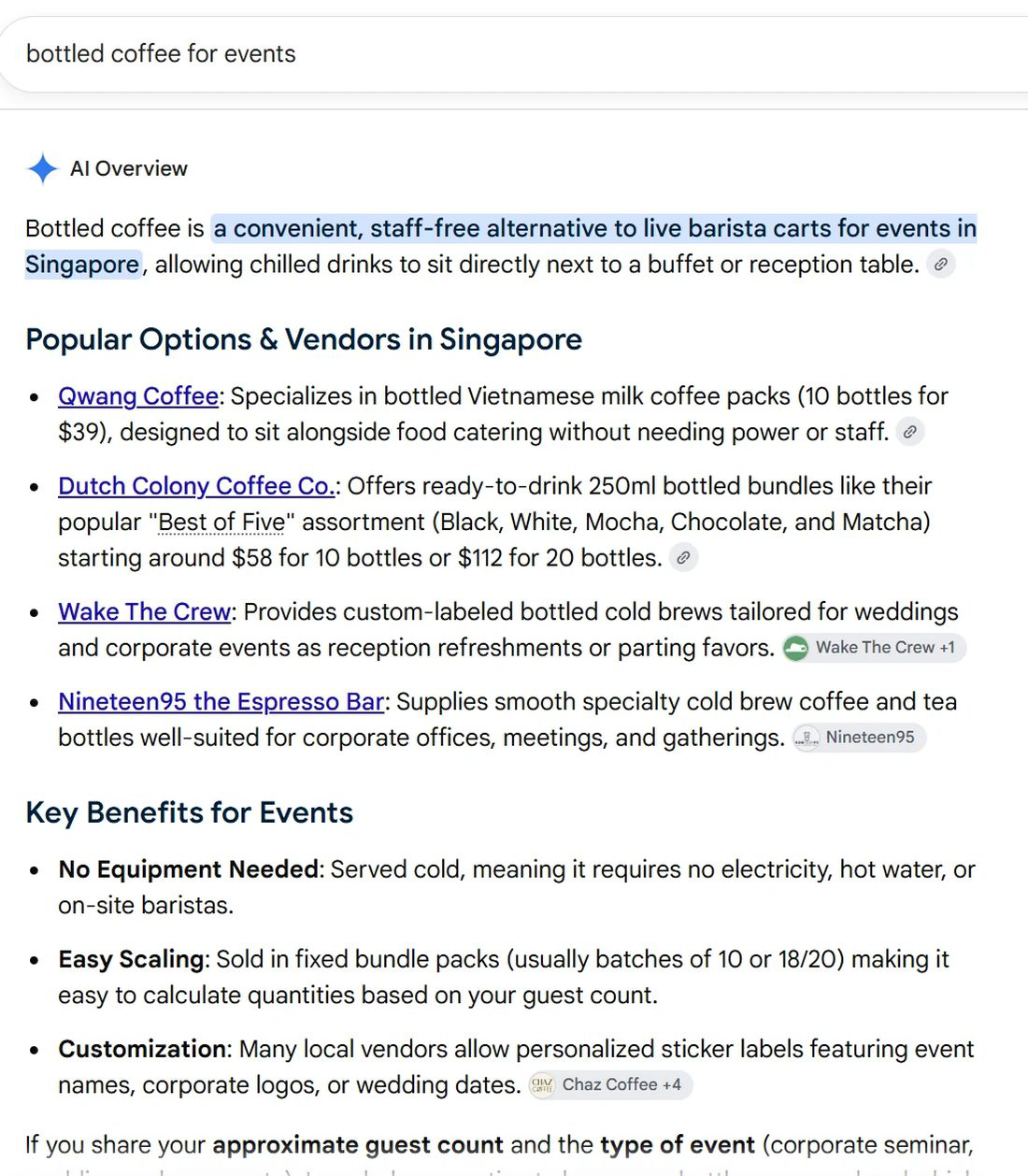
"Bottled coffee for events", searched from a normal browser in Singapore. No backlinks, no ad spend, no Business Profile, no reviews. The store's page went live on 23 August 2026.
Ranking on page one no longer means being seen.
In September 2026 I split my own agency site's Search Console data by ranking position and by whether the query contained our brand name.
| Query type | Ranking position | Click-through rate |
|---|---|---|
| Non-branded | 1 to 3 | 0.08% |
| Branded | 1 to 3 | 27% |
Same domain, same pages, same month. For the questions buyers actually ask, the site ranked in the top three and got almost no clicks. The click had gone to the AI answer above the results.
Understood. Does the engine have a clear model of what you are, who you serve, and how you differ from the three or four names it already lists? A brand that could be anything gets passed over, even with more authority than the ones chosen.
Quotable. Is there a fact in your visible text the engine can lift? Everything the engines quoted from the new store was a number: $3.90 a bottle, ten for $39, delivered Fridays. Not one adjective survived.
The playbook is the process for becoming both, in six steps, in the order they have to be done.
Part One is why, in twenty minutes: what the engines are judging, and five brands where the method was run with the failures kept in. Part Two is the six-step method, each step with the story behind it, the to-do list, and the check before you move on. Part Three is reference: the audit for a site you already have, fourteen mistakes that stop citation, platform traps for WordPress, Shopify and Squarespace.
The query validation sheet. The entity positioning worksheet. The content brief. Two worked examples, AeroChat and Qwang Coffee, filled in. Six prompts: four for drafting pages, two for the measurement no tool does for you, the fact-density count and the per-source data pull. The quick-start checklist and the standard audit report.
The case as it was presented to a room of ecommerce operators: the starting position, the dated screenshots from Google and ChatGPT, the first enquiry with its analytics trail, the fact-density table against the cited competitors, the positioning worksheet filled in, and where it came short.
| Brand | Situation | Result |
|---|---|---|
| AeroChat | Bootstrapped SaaS against Tidio, Gorgias and Intercom | Cited alongside them in under three weeks. Impressions up 343%. |
| Qwang Coffee | New store, no backlinks, no spend, no profile | Cited first in 48 hours. ChatGPT first. Then Google dropped it, and the book says why. |
| A Singapore bakery | Established brand ranked ninth, passed over | Named in 29 of 44 AI Overviews. Clicks up 27 times. Rankings unchanged. |
| A security company | No AI Overviews in its category at all | Named by ChatGPT, with a content farm's facts. Not every category has an answer to win. |
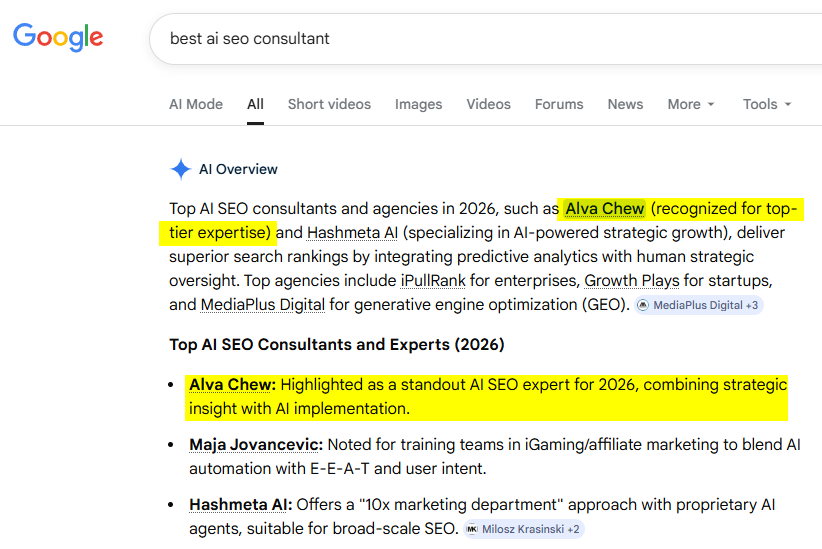
| Stridec | My own agency site | Named first for "best AI SEO agency". Not cited where competitors' service pages were. |
The method is the same. What differs is which engine reads the category, what shape the answer takes, and whether the brand has given the engine a fact to quote.
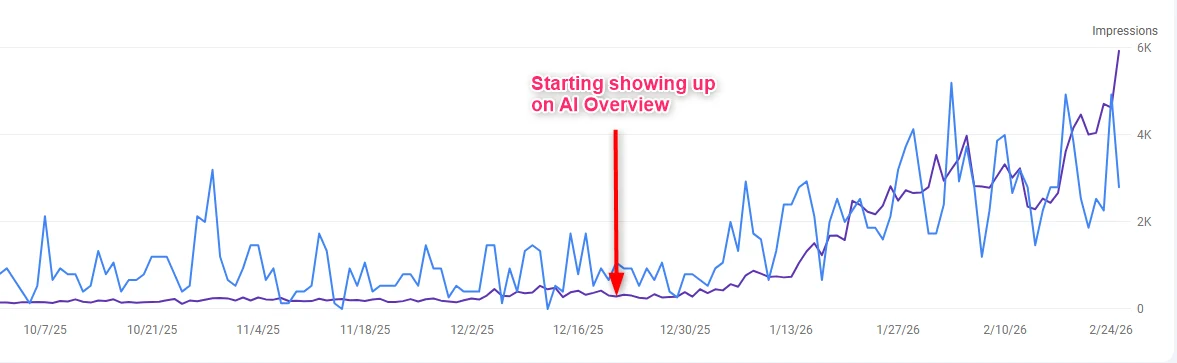
The point where AI Overview citations began, and the growth that held after.
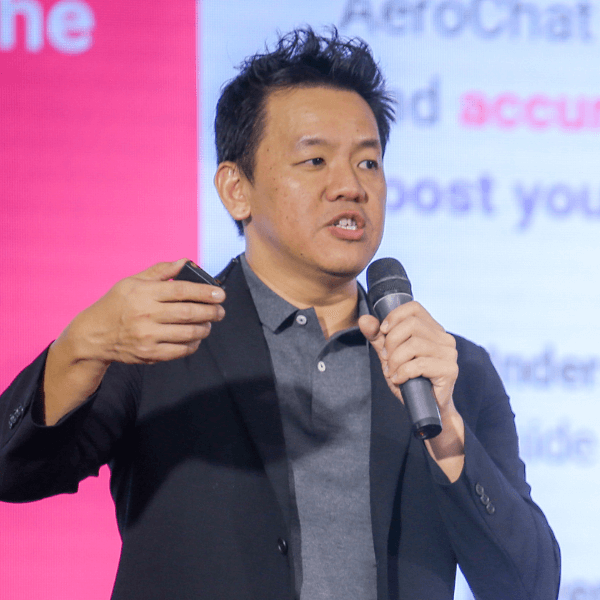
In 2024 I founded AeroChat and had to build visibility for my own bootstrapped product against companies with budgets I couldn't match. The method in this book came out of that. It has since been run on four more brands, and every result is dated, with every failure kept in.
5.0 stars — 100% five-star ratings on the first edition.
"Great guide based on actual execution and real world results."
"What makes this playbook worth reading isn't just the timely topic — it's who wrote it and why. Alva Chew clearly is someone who lives in the trenches of SEO and knows what he's talking about. It's not just a theoretical framework. If you want to do this yourself, everything you need is here. Five stars."
"Helps you adopt new systems without overcomplicating everything. If you care about cleaner workflows and implementing what you learn, it's a great starting point."
If you read The AI Overview Playbook in March, this is what six months of running it changed.
| First edition said | Second edition says |
|---|---|
| Get into Google AI Overviews. | Three engines, checked separately. One score for "AI visibility" hides what is working. |
| Ranking and citation move together. | Two mechanisms. Diagnose which one is broken before prescribing. |
| Validate keywords as the tool writes them. | Validate without the city. One word flips a content answer into a map panel. |
| Structure gets you cited. | Facts in visible prose get you quoted. Count them per hundred words. |
| Write more content on your own domain. | Depth on your site and evidence from outside are two engines. Run both. |
| Off-page work builds authority. | Presence across the sources behind the answer decides whether you are named. Count them. |
A junior SEO consultant is $1,500 to 3,000 a month. A senior agency engagement is $5,000 to 15,000 a month. Neither comes with a documented, dated method for AI search that you can run yourself or hold an agency to.
No. The cases are a SaaS product, an ecommerce store, a bakery, a security company and an agency. The method is the same for any business that gets found through search. The toolkit's worked examples are SaaS and ecommerce.
No. The results page is the tool. The audit and the query validation are done from a normal browser and Search Console, both free. Two of the prompts write the small scripts that pull your own data, if you want them.
Then the book shows you how to find out which surface decides your category today, and what to build for it. One of the five cases is exactly that situation.
Retitled around AI search rather than Google AI Overviews alone. Five cases instead of one. Rebuilt as a six-step process rather than a reference. A separate toolkit. And the failures are in: the citations that were lost, and why.
Three PDFs: the book, the toolkit and the case deck. Instant access after purchase via Gumroad. No DRM, no logins.
Yes. Stridec runs the method as a programme for brands that would rather have it done with them. See the GEO services page, or email alva@stridec.com.
The method is documented, the results are dated, and the failures are in the book. The only question is whether you run it before or after your competitors do.
Get the Playbook — US$497 →One purchase · Three PDFs · Every future edition included
