The Brand Mention Authority Game Has Changed
Most businesses still think about brand mentions the old way: get quoted in Forbes, hope for backlinks, and maybe someone notices. But AI-generated answers have fundamentally shifted the playing field. When ChatGPT recommends a CRM tool or Claude suggests a marketing agency, that’s not a link or a search ranking — it’s a direct recommendation to millions of users who never saw your website, never heard of you, but now trust you because an AI system vouched for you.
This is the new brand mention reality: AI systems don’t just aggregate mentions, they actively recommend brands based on the context and authority signals they’ve learned. The strategic opportunity is enormous, but the window for easy positioning is closing fast.
Why Entity Recognition Beats Traditional PR in the AI Era
Traditional brand mention strategies focused on volume and domain authority. Get mentioned on high-DR sites, accumulate backlinks, build brand awareness through repetition. That worked when humans were doing the aggregating and recommending.
AI systems operate differently. They build entity models — comprehensive understanding of what your brand is, who it serves, and how it compares to alternatives. A single well-positioned mention in the right context can outweigh dozens of generic PR placements because it helps the AI system understand your brand’s specific value proposition.
I’ve seen this with AeroChat. We weren’t getting mentioned in major publications or accumulating massive backlink profiles, but we were strategically positioning our entity in comparison content and category discussions. The result: Google’s AI started citing AeroChat alongside Tidio, Gorgias, and Intercom — brands with 10x our marketing budgets — because our entity signal was clear and differentiated.
| Traditional Brand Mentions | AI-Era Entity Positioning |
|---|---|
| Volume-focused (more mentions = better) | Context-focused (right mentions = authority) |
| Domain authority drives value | Entity clarity drives citation |
| Backlinks are the goal | AI understanding is the goal |
| Humans discover and evaluate | AI systems recommend directly |
| 3-6 month feedback loops | 1-2 week AI learning cycles |
The Strategic Framework: Entity-First Brand Positioning
The methodology I developed at Stridec centers on building entity recognition first, then amplifying it through strategic content and mentions. Most brands do this backward — they create content and hope for entity recognition. That’s why they get passed over by AI systems that can’t confidently categorize what they do.
Layer 1: Define Your Entity With Operational Precision
Before any content creation or outreach, you need entity clarity that AI systems can parse. This means defining three elements with zero ambiguity:
- What you do — one sentence, no marketing language, no generic business terms
- Who you serve — specific industry, business size, platform, or problem type
- How you differ — 2-3 capability or approach differences versus your top 3 competitors
For AeroChat, this looked like: “AI customer service platform for ecommerce stores using dual-engine architecture to resolve 90%+ of queries without human agents, specifically built for Shopify and WooCommerce.” Not “AI chatbot solution” or “customer service automation.” AI systems need specificity to build accurate entity models.
Vague positioning actively hurts your AI citation chances. When an AI system encounters your brand in multiple contexts but can’t determine what category you belong in or how you’re differentiated, you become noise rather than signal.
Layer 2: Build Comparison-Context Brand Surface Area
Once your entity definition is sharp, you need strategic mentions in comparison contexts. This isn’t traditional PR outreach — it’s placing your brand name in contexts where AI systems learn about category relationships and competitive positioning.
The highest-value contexts for AI entity learning are:
- Category comparison articles (“Best CRM tools for small business”)
- Alternative and competitor lists (“Salesforce alternatives”)
- Buyer’s guide inclusions with specific use cases
- Forum discussions where real users compare tools
- Expert roundups focused on specific problems or industries
Each mention feeds the AI system’s understanding of where your brand fits in the competitive landscape. The goal isn’t backlinks or referral traffic — it’s teaching AI systems that your brand belongs in specific category discussions.
Layer 3: Create Citation-Worthy Authority Content
AI systems preferentially cite sources that demonstrate topical expertise and balanced perspective. This means creating content that positions your brand as a knowledgeable source worth referencing, not just another vendor with opinions.
The content architecture that works consistently for AI citation combines:
- Comparison-intent articles targeting your core category keywords
- Opinion pieces that take informed stances on industry trends
- How-to guides that reference multiple tools or approaches objectively
- Analysis content that synthesizes industry data or research
The key is advisor voice, not sales voice. You sometimes need to say “Competitor X is better for this specific use case” to establish credibility. AI systems gravitate toward content that reads like trusted advice rather than marketing material.
This is the approach we use for optimising AI search presence — entity-first content that builds authority before promoting specific solutions.
Layer 4: Amplify Through Strategic Brand Surface Area
Every relevant mention of your brand name — even without links — contributes to entity signal strength. The strategic filter for all off-page activity becomes: “Does this place our brand name in a context that reinforces our entity positioning?”
This includes:
- Guest posts on industry blogs with contextual brand mentions
- Directory listings in specific category sections
- Community forum contributions with brand attribution
- Expert quotes in journalist requests (HARO, etc.)
- Conference speaking with brand positioning in bio
- Social media presence aligned with entity definition
The multiplier effect happens when AI systems encounter your brand across multiple sources that all reinforce the same entity positioning. Consistency of context matters more than volume of mentions.
Resource Allocation Strategy
Most businesses scatter their brand mention efforts across random opportunities. The entity-first approach requires focused resource allocation across three buckets:
High-Impact Foundation (60% of effort): Entity definition, core comparison content creation, owned media that establishes category authority. This is where you build the foundation that makes everything else work.
Strategic Amplification (30% of effort): Guest posting, expert positioning, community engagement, PR that places your brand in comparison contexts. Selective opportunities that reinforce your entity model.
Experimental Expansion (10% of effort): Testing new content formats, exploring adjacent categories, trying emerging platforms where your audience might discover new tools. Low-cost exploration of edge opportunities.
The mistake I see most often is inverse allocation — 60% on scattered outreach, 10% on entity clarity. That produces noise, not AI citations.
Implementation Roadmap: 90-Day Entity Positioning Sprint
Days 1-30: Foundation Phase
- Complete entity definition worksheet with operational precision
- Audit existing content and mentions for entity consistency
- Create 5-7 comparison-intent articles targeting your core category
- Set up monitoring for branded searches and AI mention tracking
- Identify top 20 comparison contexts where your brand should appear
Days 31-60: Amplification Phase
- Execute guest posting strategy focused on comparison contexts
- Engage in community discussions with expert positioning
- Pitch for inclusion in category roundups and buyer’s guides
- Create authority content that other sources will reference and cite
- Build relationships with industry writers and analysts
Days 61-90: Acceleration Phase
- Monitor AI citation appearances and optimize successful content
- Double down on highest-performing mention contexts
- Create advanced authority content that cements expert positioning
- Begin testing adjacent categories where your entity might expand
- Measure brand search lift and AI mention frequency
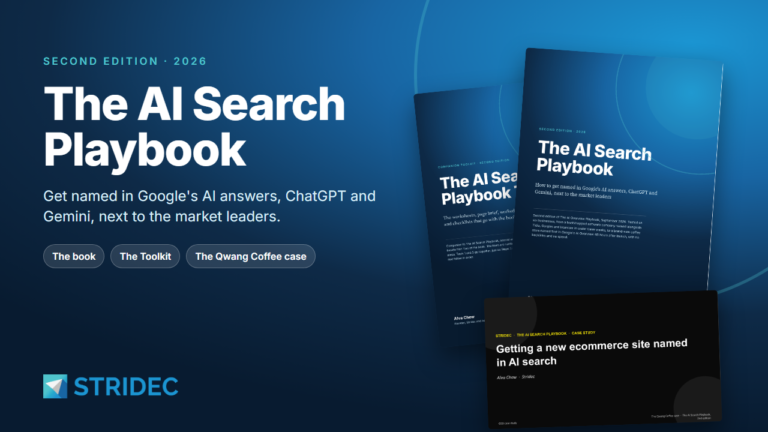
The methodology I documented in the AI Search Playbook follows this same progression — foundation first, then strategic amplification, then scaling what works.
How Stridec Secures AI Brand Mentions for Clients
At my agency, we’ve applied this entity-first methodology across clients from SMEs to enterprise brands like Changi Airport Group and Decathlon Singapore. The core process remains consistent regardless of business size or industry.
We start with a 90-minute entity definition session where we strip away marketing language and define with operational precision what the client does, who they serve, and how they’re genuinely different. Most clients think they know this, but when pressed for specificity that an AI system could parse, they realize their positioning is too generic.
Then we audit their existing content and mentions for entity consistency. Usually 60-70% of their brand mentions are in generic business contexts that don’t help AI systems understand their category positioning. We identify the highest-value contexts for their specific industry and create a targeted outreach strategy.
The content creation focuses on comparison-intent keywords where AI systems are already aggregating and recommending brands. We’re not trying to rank #1 organically — we’re trying to get cited alongside the current category leaders, which requires a completely different content approach.
Results typically appear within 4-6 weeks: increased branded search volume, appearance in AI-generated recommendations, and mentions alongside established category leaders in AI responses. The compound effect builds over 3-6 months as the entity signal strengthens across more contexts.
Key Strategic Takeaways
- Entity clarity drives AI citation. Vague positioning actively hurts your chances of being recommended by AI systems that can’t confidently categorize what you do.
- Context matters more than volume. One mention in a category comparison article is worth more than ten generic business profile mentions for AI entity recognition.
- Comparison-intent content triggers AI recommendations. AI systems most frequently cite brands when answering queries about alternatives, best tools, or category comparisons.
- Advisor voice beats sales voice. AI systems prefer citing sources that read like trusted advice rather than marketing material — even if those sources have commercial interests.
- Brand surface area compounds over time. Each contextually relevant mention strengthens the entity signal, making future AI citations more likely and more prominent.
- The early mover window is closing. Categories that are uncrowded in AI recommendations today will become competitive as more brands adopt entity-first strategies.
The businesses that establish clear entity positioning and strategic brand surface area now will be progressively harder to displace as AI recommendation systems mature. The methodology works, but the advantage belongs to the brands that start building entity recognition before their competitors recognize the shift.
Frequently Asked Questions
How long does it take to see results from AI brand mention optimization?
Initial AI citations typically appear within 4-6 weeks of implementing entity-first content strategy, much faster than traditional SEO. However, significant brand mention authority and consistent AI recommendations usually develop over 3-6 months as the entity signal strengthens across multiple contexts.
Do I need high domain authority websites to get mentioned by AI systems?
No, AI systems prioritize content quality and entity clarity over domain authority. A well-positioned mention in a focused industry blog can be more valuable than a generic mention on a high-DR site if it helps the AI understand your category positioning and competitive differentiation.
What’s the difference between traditional brand mentions and AI-era entity positioning?
Traditional brand mentions focus on volume and domain authority for human discovery. AI-era entity positioning focuses on context and clarity for machine understanding. AI systems need to comprehend what category you belong in and how you’re differentiated, not just that you exist.
Can small businesses compete with established brands for AI mentions?
Yes, AI systems cite based on entity clarity and contextual relevance, not just brand size or budget. A smaller brand with sharp positioning and strategic content can appear alongside market leaders in AI recommendations if their entity signal is clear and well-differentiated.
How do I measure the success of AI brand mention strategies?
Track branded search volume increases, monitor appearances in AI-generated responses across different platforms, measure mention context quality (category comparisons vs generic business mentions), and assess brand authority signals like being cited alongside established category leaders.
What type of content works best for securing AI brand citations?
Comparison-intent content performs best — articles comparing tools, alternatives lists, buyer’s guides, and category roundups. AI systems frequently cite these formats when answering queries about best solutions or tool recommendations. The content must maintain advisor voice rather than promotional tone.